

Assemble the package in days.Approve every call yourself.
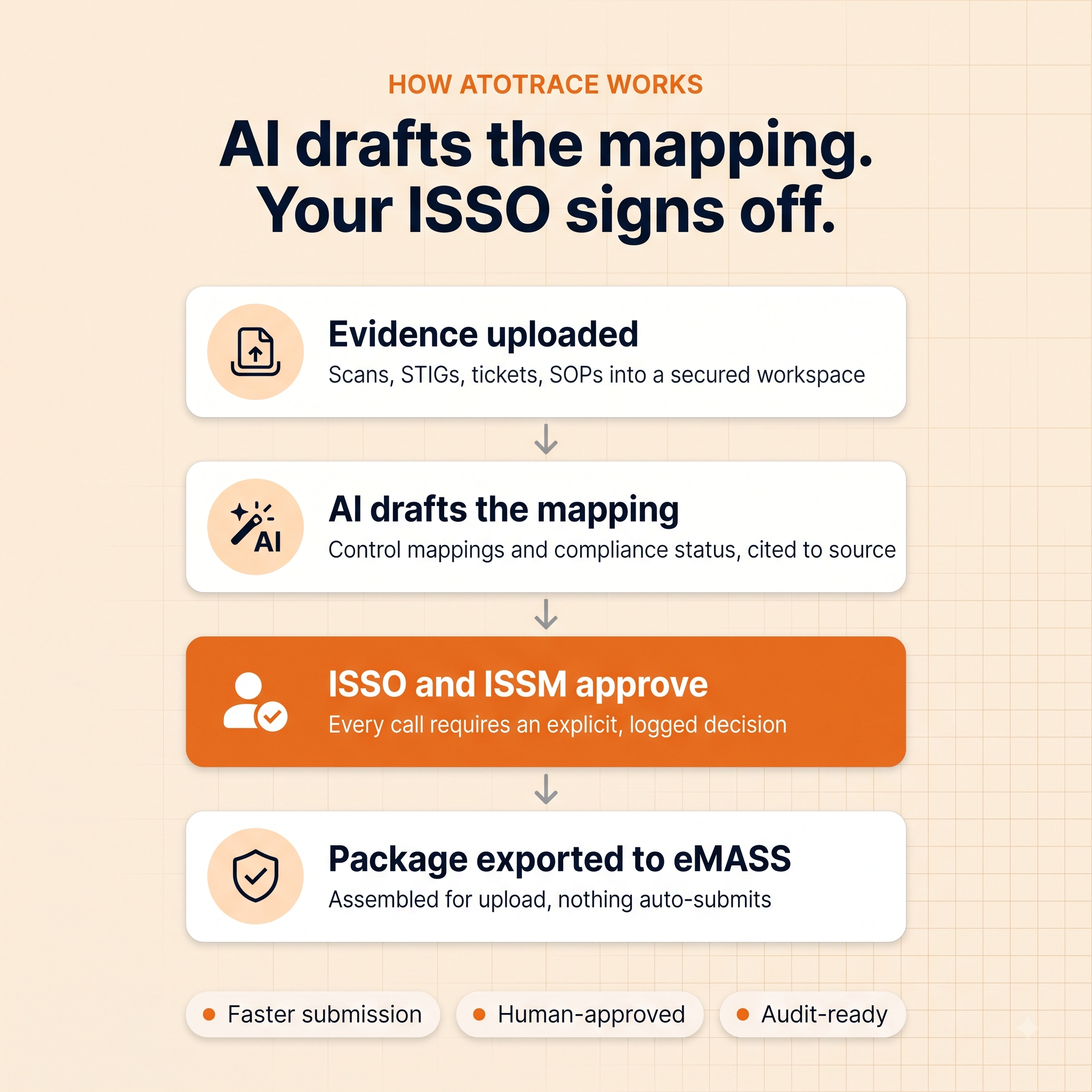
ATOTrace is AI-assisted RMF evidence and eMASS packaging software for federal security teams. This Patent Pending software reads the evidence your program already produces, like scans, STIG checklists, tickets, SOPs, and configuration exports, and drafts control mappings, compliance statuses, and POA&M entries against your existing SSP baseline. Every draft lands in front of your ISSO and ISSM for explicit approval. Nothing is locked, and nothing is exported, without a logged human decision.
Engineering-complete is not operational.
The technical work finishes on schedule. The cutover is tested, the upgrade is staged, the new capability is ready. Then the whole thing sits and waits while the ATO package comes together. The package is the long pole nobody owns. ISSOs and ISSMs gather evidence, map it to controls, draft POA&Ms, and reformat everything for eMASS by hand, in between every other thing the mission demands of them. RMF rides on top of the day job, not instead of it. And when the package slips, it is the project schedule that gets briefed upward, not the security shop's workload.
The timeline math is unforgiving. A traditional DoD ATO cycle is widely reported to run 6 to 24 months or more before any rework. The review queue is first come, first served. A package that comes back for correction does not resume its place in line — it re-enters the queue at the end. Two things upstream of the reviewer can still be controlled: when the package is submitted, and how good it is when it lands. Manual assembly makes both of those worse.
Evidence-to-control mapping, compliance-status writeups, and POA&M drafting consume the hours of the exact people you need thinking about risk. Under deadline pressure, structured work done by hand is where errors and gaps get introduced. And when an assessor asks how a particular compliance call was reached, the answer is reconstructed from memory and email rather than read off a record.
ATOTrace solves this exact problem.
Built around how RMF packages actually get assembled.
ATOTrace does not replace your ISSO, your ISSM, your Security Control Assessor, or your Authorizing Official. It removes the low-value assembly labor between them and gives every compliance call a citation back to the evidence it came from. The AI drafts. The human decides. The system records both.
Evidence ingestion and control mapping
Upload the artifacts your program already generates: vulnerability scans, STIG checklists, trouble tickets, standard operating procedures, configuration exports, and your existing SSP. ATOTrace parses them with retrieval-augmented generation (RAG), extracts structured findings, and suggests mappings against your control baseline. Where evidence is thin or missing, it flags the coverage gap instead of quietly filling it.
Cited compliance-status drafting
ATOTrace proposes a compliance status for each control with written rationale, traced to NIST SP 800-53A assessment procedures and grounded in the specific uploaded artifact it came from. Nothing is asserted without a citation back to source evidence. The status is a draft until a human confirms it.
Structural approval gates, not advisory ones
The approval requirement is enforced in the system's structure, through status fields and blocked exports, not through policy or training. Compliance statuses, POA&M creation, POA&M edits, POA&M closures, risk and severity ratings, and final package export each require an explicit, logged human decision. There is no configuration that turns this off. AI empowerment, not AI replacement, is an intentional design constraint (Patent Pending), not a marketing line.
POA&M drafting and eMASS-ready export
ATOTrace drafts POA&M entries with weakness description, mitigation, milestones, resources, and due date, then assembles approved artifacts into an export package. It drafts into eMASS's own published import templates for Test Results and Control Information rather than into a proprietary format, so the output goes in as an import rather than a retype. Nothing auto-submits. The package is assembled for your team to upload after ISSM sign-off.
A dedicated instance for your agency
ATOTrace is built around DoD-wide standards rather than any one organization's. RMF, eMASS, NIST SP 800-53A, STIG and ACAS evidence, and the ISSO and ISSM roles work the same way across the department, so the core product does not need to be rewritten to fit your command. What does change is the instance: each agency gets its own environment, its own configuration and terminology, and its own isolated database. Your evidence, your control baseline, and your package never share a tenant with anyone else's.
A workflow that fits inside the process you already run.
Start from your baseline
Load your existing SSP and control baseline. ATOTrace works against the accreditation boundary and control set you already have. It does not ask you to restructure your package or adopt a different control framework.
Upload the evidence you already have
Drop in scans, checklists, tickets, SOPs, and configuration exports in PDF, XLSX, CSV, or DOCX. ATOTrace parses each artifact, extracts findings, and holds them as structured evidence tied to their source file.
Review the drafted mappings and statuses
The ISSO works through AI-suggested evidence-to-control mappings and drafted compliance statuses. Each one carries its rationale and its citation. Accept, edit, or reject. Coverage gaps surface on a dashboard so the thin areas are visible before an assessor finds them.
Draft and approve POA&Ms
For every non-compliant or partially compliant control, ATOTrace drafts a POA&M entry. The ISSO refines it. Creation, edit, and closure are each gated on an explicit approval, and each approval is written to the audit trail with the AI prompt, the AI response, and the human decision.
Assemble, sign off, export
Once the ISSM approves, ATOTrace assembles the approved artifacts into an eMASS-ready package. Your team uploads it. Nothing leaves the system automatically, and nothing reaches eMASS without a logged human decision behind it.
What this changes, in plain terms.
Submission date becomes something you control
In a first-come, first-served review queue, the submission date is one of the few variables upstream of the reviewer that a program can still influence. Compressing assembly time moves the submission date left, and in RMF, early is on time.
Low-value touch labor comes off the security shop
Manual evidence-to-control mapping, POA&M formatting, and eMASS template wrangling consume ISSO and ISSM hours that should go to risk judgment. ATOTrace absorbs the assembly work and leaves the decisions where they belong.
A record that reconstructs itself
Every compliance call carries its evidence citation, its AI-drafted rationale, and the human decision that locked it, with a timestamp and a user. When an assessor asks how the team got to a status six months later, the answer is read from the record rather than rebuilt from memory.
Standards traceability built into the artifact
Drafted compliance rationale is traced to NIST SP 800-53 Rev 5 controls and NIST SP 800-53A assessment procedures, consistent with the RMF process described in DoDI 8510.01. Traceability is a property of the output, not a separate documentation exercise.
Built for the ISSO and the ISSM, together.
ISSOs
The day-to-day operator. Upload the cycle's evidence, work through drafted mappings and compliance statuses, refine and approve POA&M entries, and watch the gap-coverage dashboard instead of building a coverage spreadsheet by hand. The blank-page problem goes away. The judgment stays yours.
ISSMs and security control assessors
Oversight and final authority. Review what the ISSO approved, give final sign-off on package assembly and export, and own an audit trail that reconstructs any decision on demand. Consistency across systems and across cycles stops depending on who assembled the package that quarter.
Program and project managers
The schedule variance from a slipping ATO package lands on you, not on the security shop. ATOTrace gives you a compression lever on the one part of the timeline that is still inside your control, plus visibility into where the package actually stands rather than a status you have to chase.
Human control is the architecture, not a setting.
A tool that touches accreditation artifacts has to be more conservative than the systems it documents. ATOTrace is built so that the AI can never be the last decision-maker on anything that reaches eMASS, and so that any call it contributed to can be reconstructed later in full.
- Compliance status requires explicit human approval before it locks
- POA&M creation, edit, and closure each gated on a logged decision
- Risk and severity ratings require human confirmation
- Final package assembly and export blocked pending ISSM sign-off
- No configuration option disables the approval gates
- Every drafted compliance call cites the source artifact it came from
- Nothing is asserted without a traceable citation to uploaded evidence
- Coverage gaps are flagged rather than inferred or filled
- Drafted rationale traced to NIST SP 800-53A assessment procedures
- Audit trail logs the AI prompt, the AI response, and the human decision
- Any compliance call is reconstructable end to end after the fact
- Role-based access control separating ISSO and ISSM authority
- Approval history retained with user and timestamp on every state change
- Control mapping against NIST SP 800-53 Rev 5 baselines
- Assessment rationale aligned to NIST SP 800-53A
- Built around the RMF process described in DoDI 8510.01
- Export drafted into eMASS's published import template structure
- Architecture is environment-agnostic, so hosting is a deployment-time decision
A federal IT company building federal AI.
IPNS supports the U.S. Army Corps of Engineers, the Air Force, DISA, and other agencies in cybersecurity, cloud services, software development, and managed services. We do RMF and ATO work as a services company. ATOTrace exists because our own practitioners kept assembling these packages by hand and knew exactly which parts of it did not need a human.
We are not an AI startup learning federal compliance. We are a federal IT services company applying AI to a process we already run for our customers.
Common questions from federal security teams.
Does ATOTrace make compliance determinations?
Does anything submit to eMASS automatically?
How do you handle hallucination risk on accreditation artifacts?
Does it replace our GRC platform?
What evidence formats does it accept?
Can it run inside our environment, and is our data separated from anyone else's?
See it run, then tell us where it breaks.
ATOTrace is being shaped by feedback from the people who assemble these packages for a living. If you run RMF, eMASS, or security compliance for a federal program, we'll walk you through a working version of the tool. We want to hear where it doesn't match how the work actually gets done at your unique organization. Thirty minutes for a technical conversation, an hour if you want the full walkthrough. No commitment, no procurement action, and nothing tied to existing contract work.
Ready to move your submission date left?
ATOTrace compresses the assembly work between the evidence your program already has and the package your reviewer receives, without ever letting an AI make the call. If ATO timelines are the long pole on your schedule, we would like to show you the working tool and see how we can help you make progress faster.